
Play and Quantum Physics

Quantum physics tells us that:
Particles can exist in multiple states at once (superposition)
Observation changes the outcome (observer effect)
Reality at its smallest scales is unpredictable, relational, and probabilistic, not fixed
Now think about play, especially from the point of view of the Original Learning approach:
Children explore multiple possibilities at once (a stick is a wand, a sword, a fishing rod…)
The act of observation by an adult can change the play
Play is not linear or outcome-driven - it’s emergent, creative, often chaotic, and relational
Connection: Both quantum physics and play recognise that reality is not fixed, but fluid, relational, and open to possibility.
This is why quantum physics fascinates me, and has done particularly after attending a lecture at the Nobel Prize Museum here in Stockholm where a former Nobel prize winner (now forget his name) was talking about quantum physics and in my note book I was making parallels to play the entire time. I have, though, avoided writing much about it, because, well, I felt so out of my depth in the quantum realm, so to speak.
But today I felt it was time to give it a go - to make connections between play, Original Learning and quantum physics.
Quantum physics embraces uncertainty as a fundamental truth of the universe.
Likewise, in play:
Children don’t need to know where something is “going” - they explore without fixed outcomes
Educators in OLA step into the unknown with the child, allowing meaning to emerge together
Play invites risk, creativity, and intuition, not just logic or correctness
“Not knowing” is not a failure - it’s where discovery begins.
Quantum physics shows us that particles are entangled - one affects the other instantly, even at a distance.
In play:
Children’s ideas, actions, and emotions are entangled with others - play is deeply social
The environment, materials, and adult presence all influence the play, even subtly
OLA views learning as a relational process, where knowledge is co-constructed, not delivered
Play and quantum physics both collapse the idea of individualism and remind us that everything is connected.
Quantum theories often challenge our imagination - they’re not directly visible, but they require imaginative models (like wave-particle duality, or Schrödinger’s cat).
In play:
Children construct complex, imaginative worlds to understand reality
They test theories through symbolic or pretend play — “What if?” is the foundation of both (although play is not exclusively what if)
Both quantum physics and play stretch our capacity to imagine beyond what we can see.
In quantum physics, the act of observing changes the state of what is being observed. In play, especially in OLA:
The adult’s presence and attitude affect the play and learning - interrupting it, deepening it, or shifting its direction. This is not necessarily bad or good, it is something we need to be aware of in order to avoid having negative impacts on the children, their learning and their play as much as is possible.
The adult must practice “quantum listening” - being present without dominating, or as I call it in my book - visibly invisible. The children know where we are when they need us but our presence interferes minimally when they don’t need us.
How we document, interpret, or narrate play changes its meaning. Our own bias and subjectivity will impact how and what we notice and how we understand the actions, desires and interactions of and with the children.
The observer is never neutral. We must ask: What is my role in shaping what I see?
Quantum physics teaches us that the universe is more playful and strange than we can imagine.
Children, through play, already live in that universe.
From an Original Learning Approach perspective, bringing quantum thinking into education means embracing:
Uncertainty over fixed outcomes
Relationship over isolation
Possibility over prescription
Process over product
Curiosity over control
This is exactly the kind of pedagogical shift that OLA is advocating - one that’s more aligned with how reality actually works, according to quantum science.
Researchers & Thinkers to Explore
Karen Barad – Quantum Physics, Feminist Theory, Ontology (the reason why I travelled to Copenhagen last week was to listen to Karen Barad in person, but sadly it was cancelled last minute… so I filled my time with other delightful meetings on play)
Key work: Meeting the Universe Halfway (2007)
A physicist and feminist theorist who developed agential realism - the idea that nothing pre-exists its interaction; reality is co-constructed.
She draws heavily from quantum entanglement and applies it to learning, identity, and meaning-making.
Her work is increasingly influential in posthuman early childhood education.
Connection to play: Play as relational, emergent, and always in-the-making - not something isolated or measurable.
“Knowing is a matter of part of the world making itself intelligible to another part.” - Barad
Gilles Deleuze & Félix Guattari – Philosophy, Creativity, Rhizomes
Not physicists, but their concepts like rhizomatic thinking, becoming, and multiplicity echo quantum ideas. (you will notice that I use these terms in my book)
They challenge linear, binary thinking - much like quantum physics does.
Widely used in educational philosophy (including Reggio and OLA).
Connection to play: Play as a non-linear, generative force, not a path to a single outcome.
Brian Sutton-Smith – Playwork Theory (my playwork training also has quantum physics connections)
His book The Ambiguity of Play (1997) outlines how play is filled with paradoxes, contradictions, and possibilities.
He famously said that play is about “the possibility of the impossible.”
Connection to quantum physics: This view of play embraces uncertainty and multitudes - much like quantum theory’s rejection of fixed truths.
Loris Malaguzzi – Reggio Emilia Approach
Not a quantum physicist, but his “hundred languages of children” approach embraces multiple truths, creativity, and fluid learning.
Malaguzzi’s view of the child as “rich in potential” aligns with quantum openness and the idea of possibility over prescription.
Connection to play: He treats play as serious exploration of the world - deeply connected to perception, imagination, and agency.
Fritjof Capra – Physicist, Systems Thinker
Author of The Tao of Physics and The Web of Life
Explores how quantum physics intersects with systems theory, spirituality, and ecology.
Connection to education and play: His work supports a holistic worldview, which underpins play-based, emergent education. He doesn’t write about play directly, but his systemic view helps justify non-linear, organic learning models like OLA. I personally think there is a lot of work, that is not directly connected to play, that enables us to better understand play, as it gives us words, analogies and systems that prise open new windows to perceive what we thought we already knew.
Gert Biesta – Philosophy of Education
Not a physicist, but he critiques outcomes-based education, favouring interruption, encounter, and subjectification — ideas resonant with quantum thinking. I really value his concept of the world at the centre instead of the child, or the learning or the teaching - because then we can weave together playing, learning and teaching to respond to an ever changing and uncertain world.
Connection to play: Play as a space for the unpredictable emergence of the subject - not merely skill development.
Maxine Greene – Aesthetic Education, Imagination
Advocates for imagination, uncertainty, and possibility in learning.
While not linking directly to quantum physics, her work supports educational environments that mirror quantum principles - open-ended, relational, poetic. Just as OLA is not directly linked to quantum physics, yet it mirrors many quantum principles.'
No single researcher “owns” the intersection of quantum physics and play, this is merely something that I find fascinating, as do many others.
As a child, and in to my adulthood I have long been fascinated my realms within realms - Narnia, Marvel Multiverse etc I have previously written posts about how play often makes time behave differently, as if in another realm/dimension.
So if we explore quantum physics through the lens of Narnia, it can give us another way of understanding the connections between it and play and learning.
In quantum physics, the Many Worlds Interpretation suggests that all possible outcomes of a quantum event actually occur — in separate, branching realities.
Just like Lucy steps through a wardrobe and finds herself in another world, quantum theory proposes that multiple worlds might be existing alongside ours, unseen but no less real.
Narnia is not a dream — it’s a coexisting reality.
The wardrobe is a threshold between dimensions, like a quantum tunnel.
Each time the Pevensies enter Narnia, time flows differently — mirroring the idea that time and space are relative, not fixed.
In quantum mechanics, the observer effect suggests that consciousness impacts the observed reality. At the subatomic level, particles behave differently when observed.
In Narnia, only certain people can access the wardrobe — usually children who are open, curious, and not bound by logic or adult expectations.
Lucy believes, and so she sees.
Adults try the wardrobe and see only coats - they can’t perceive Narnia because their mindset is fixed.
This mirrors the quantum idea that reality is not just “out there” - it’s shaped by how we engage with it.
Quantum particles can exist in superposition — holding multiple states at once - until measured or collapsed into one outcome.
The wardrobe is both a piece of furniture and a portal - until it’s entered. Like Schrödinger’s cat, it is both ordinary and magical.
Narnia and “real life” exist simultaneously - not either/or, but both/and.
The children move between worlds, holding dual identities (e.g., ordinary children and kings/queens).
Just like quantum states, their identities and experiences depend on context and collapse differently depending on perspective.
In quantum theory and Einstein’s relativity, time is not constant - it bends, stretches, and behaves differently depending on speed, gravity, or perspective.
In Narnia, decades can pass, yet only a few seconds go by in the “real” world. This is textbook time dilation.
Time in Narnia follows its own quantum logic - it’s not linear or predictable.
The wardrobe acts like a wormhole - a shortcut through spacetime.
Quantum physics pushes us beyond the limits of what we can see - asking us to imagine invisible forces, dimensions, and entanglements.
Narnia is not just a fantasy realm - it’s a metaphor for the expanded reality available to those who are open, brave, and imaginative enough to see beyond surfaces.
The wardrobe isn’t a fantasy escape — it’s a symbol of expanded consciousness.
Narnia teaches the children about courage, morality, wonder, and truth - lessons as real and lasting as anything learned in the physical world.
In this way, Narnia is a quantum experience: it changes those who enter it.
C.S. Lewis wasn’t writing a physics textbook - but his work is quantum in spirit.
Narnia invites us to see that reality is bigger than what we’re told.
Quantum physics tells us that matter is stranger, softer, and more poetic than we think.
Both challenge us to imagine other possibilities, to trust intuition, and to honour the mystery of existence.
Playwork (yes, coming back to playwork again) and quantum physics might sound like an unlikely pair - one rooted in muddy playgrounds, the other in particle accelerators - but they are deeply connected in how they both engage with possibility, uncertainty, emergence, and relationality.
In fact, seeing playwork through a quantum lens can help us reframe it not just as a practice of adult supervision and/or activity provision, but as a relational, open-ended, co-creative engagement with the unknown - a space where reality unfolds through play.
In a classical view, an educator or adult directs, controls, and/or corrects. But a playworker:
Listens without interrupting
Holds space without shaping outcomes
Intervenes only to protect the play, not to lead it
Understands that even a subtle gesture, word, or body shift can shift the energy of a play moment
This is quantum - working in relationship with the field, not over it. The playworker is like a quantum field facilitator - attuned to invisible forces, subtle shifts, and emergent realities.
As the Original Learning Approach advocates for three role - the teacher, the facilitator and the playworker I think it is valuable to explore the role of playworker through a quantum lens to help us:
Validate play as a complex, living system - not a childish diversion (especially as we seem to have a bias that “childish” is something negative and a waste of time, while in reality being a child is a vital part of being human)
Recognise the depth of the playworker role — not just supervision, but attunement to the unknown
Honour children as creators of reality, not empty vessels that need to be filled with adult approved content
Develop language and theory that supports play’s deeper value in a world obsessed with outcomes and control - as I mentioned earlier - studying subjects other than play, learning and teaching can provide us with the language and theory that helps us better communicate and advocate about and for play.
Play is not a rehearsal for life — it’s the quantum unfolding of life itself.
Playwork is the art of holding that space — without collapsing it.
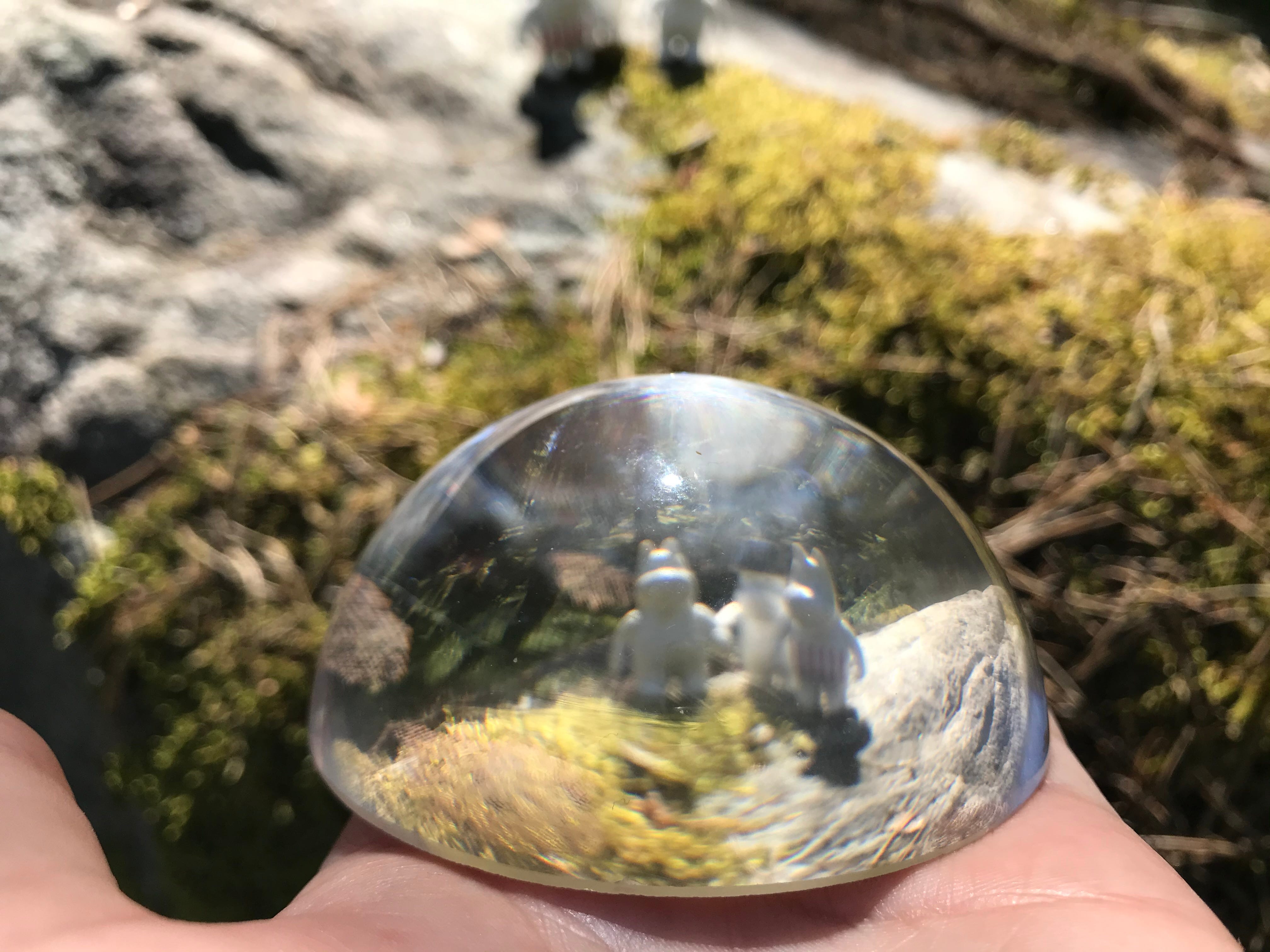
The Moomins also fascinate me - how these trolls feel both tiny and human sized at the same time - both real and imaginative - and Moomin Mamma’s bag that always has exactly the right thing at the right time within it, no matter what… the impossible being possible.
Hopefully this text has got you excited about how quantum physics can help us find the language and theory needed to advocate for play. I also think that this post connects to one I wrote last year -
I remember speaking with a father in the class a four year-olds I was learning and teaching with. it was about 15 years ago. he was a neuroscientist in Hong Kong. I mentioned the idea that children are like electrons and he could see the connection. your article Suzanne goes into depth of how play and quantum physics relate. it is very inspiring and humbling. thank you for sharing it.
This read absollutely thrills me, some of the authors introduced here I have read the work, and those I didn't I am gratefull I got introduced now. I am amazed by quantum physics and how when one delves deeper there is opening of interconectedness, posibilities, it shifts power of the creation of anything to the self but in the sense of mwe or togethernes, where one is always in relation to the other, human and how you state more than human. Also I just love the knowingness. This field of awareness where one is connected to all and where knowing is just there for one to read if a person listens deeply, with the entirety of the being.